Mossman Gorge Guide: Boardwalks, River Safety And The Shuttle
Mossman Gorge is the closest piece of the Daintree to Port Douglas, an easy twenty minutes up the road, and the gentlest way into rainforest that has been growing for over 180 million years. Here is how the shuttle works, which walks pay off, what QPWS says about swimming, and when to go.
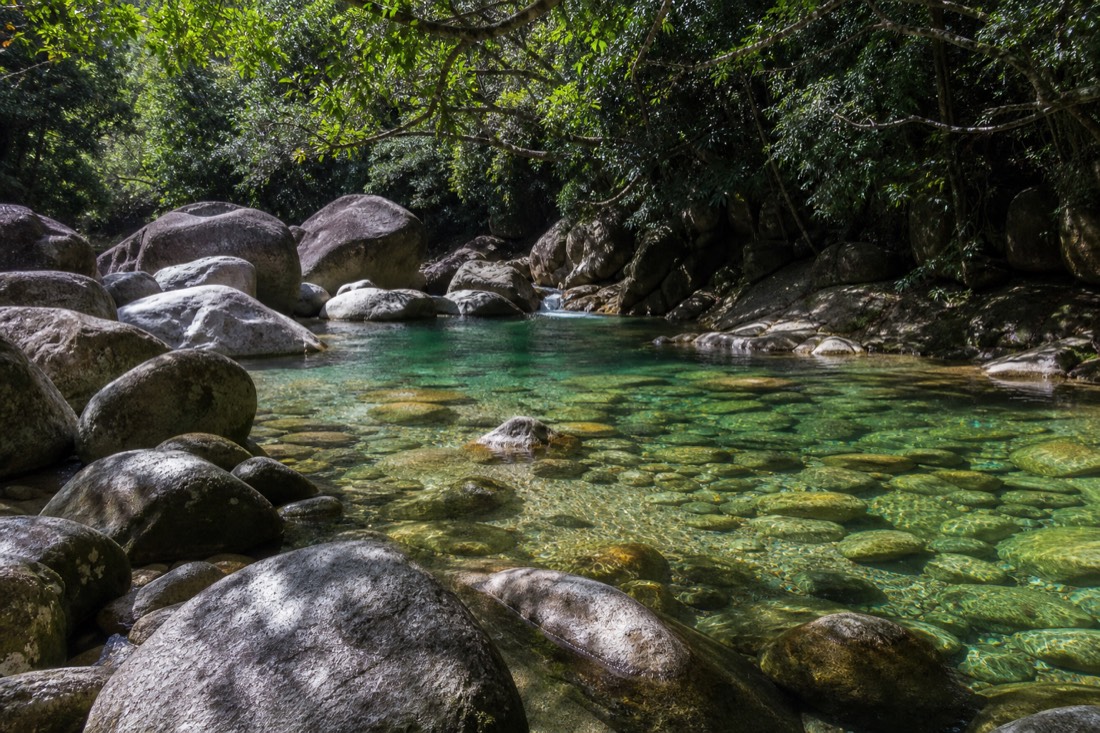
The water at Mossman Gorge runs so clear over the granite that you can watch small fish hold steady in the current a metre down. This is the southern doorway to the Daintree, the slice of forest closest to Port Douglas, and for a lot of people it is the first ancient rainforest they ever stand inside. It sits on the Mossman River, on Kuku Yalanji country, in forest whose plant lineages reach back over 180 million years.
Booking Choice: For Port Douglas travelers aged 7–85 who can manage uneven ground, start with this nine-hour small-group day combining Mossman Gorge, guided walks, the Daintree River and Cape Tribulation.
Check Dates For The Port Douglas Daintree Small-Group TourMost of the full-day trips listed by Daintree Rainforest Tours start their morning here, because the gorge is close, gentle and genuinely spectacular. This guide covers the shuttle from the visitor centre, the boardwalk and circuit walks, the river and why QPWS does not recommend swimming there, the Kuku Yalanji cultural walk, the best time of day to beat the coaches, and what to throw in your bag before you go.
At a glance: how long each Mossman Gorge walk takes
Approximate on-foot times. Track lengths and closures change, so read the trailhead sign.
What Is Mossman Gorge, And Where Does It Sit In The Daintree?
Mossman Gorge is the southern entrance to the Daintree Rainforest, set on the Mossman River about twenty minutes north of Port Douglas. It sits on Kuku Yalanji country inside the Wet Tropics of Queensland World Heritage Area, where cold, clear water runs over granite boulders through some of the oldest forest on Earth.
The gorge is where the Mossman River drops out of the ranges and spreads over smooth granite, framed by dense lowland rainforest. This is part of the largest continuous stretch of tropical rainforest in Australia, a place where fan palms, strangler figs and primitive flowering plants trace direct lines back to the Gondwana supercontinent. Standing on the riverbank, you are looking at a plant community that survived the extinction event that finished the dinosaurs.
People sometimes picture the Daintree as one thing, but it has two very different faces. The far northern end, where the forest runs straight into the sea, is the drama you reach by crossing the cable ferry to a day at Cape Tribulation. Mossman Gorge is the other face: accessible, well maintained, no ferry required, and the correct place to start if you want to actually understand what you are looking at. Families in particular may find the elevated boardwalk near the entrance less demanding than the full circuit. QPWS does not recommend swimming or paddling in the river because currents and submerged hazards are unpredictable. It is the most visited single site in the region, and it repays more time than the average visitor gives it. The whole area is protected as part of the Wet Tropics of Queensland World Heritage Area, one of the reasons access is managed the way it is.
Two things make this forest genuinely rare rather than just pretty. It is one of the oldest continuously surviving rainforests anywhere, carrying plant families that have no living relatives left on Earth, and it is the largest continuous stretch of tropical rainforest in Australia. Standing under it, you are not looking at a replanted or recovered forest but at a living remnant of something far older, which is exactly why the interpretation you get on a good walk changes how you see the place.
How Do You Get To Mossman Gorge From Port Douglas And Cairns?
From Port Douglas the drive is short, roughly twenty to thirty minutes north on sealed road with no ferry to cross. From Cairns city allow about an hour and a half up the Captain Cook Highway. A standard 2WD car handles the whole route, and the road stops at the Mossman Gorge Centre, where a shuttle takes you the last stretch.
The Captain Cook Highway is a sealed coastal road the entire way, so you do not need a four-wheel drive to reach the gorge, and unlike the trip up to Cape Tribulation you never cross the Daintree River. Mossman Gorge sits just west of the town of Mossman, a couple of minutes off the highway. If you are weighing up where to base yourself, staying at Port Douglas saves roughly forty-five minutes of driving each way compared with Cairns, which matters most on an early start. It is one of the main reasons to think about whether to base yourself in Cairns or Port Douglas before you book anything.
| Starting point | Approx driving time | Notes |
|---|---|---|
| Port Douglas | 20 to 30 minutes | Closest base, sealed road, no ferry |
| Cairns Northern Beaches | a little over an hour | Along the coastal highway |
| Cairns city centre | about 1.5 hours | Captain Cook Highway the whole way |
| Cairns Airport | about 1.5 hours | Head north, bypass the city |
If you would rather not drive at all, a guided day trip handles the timing, the parking and the shuttle for you, and most Mossman Gorge itineraries pair the walk with a river cruise and a run further north. That is covered further down, along with driving up from Cairns and across the ferry if you plan to keep going after the gorge.
How Does The Mossman Gorge Shuttle Bus Work?
Private vehicles stop at the Mossman Gorge Centre, and a shuttle bus carries visitors the short final stretch to the walking tracks. It runs regularly through the day. Fares and departure frequency change, so check the current rate with the Mossman Gorge Centre before you go rather than assuming a price.
The shuttle exists to keep traffic and parking out of a fragile site, and it is the standard way in. You park at the centre, buy your shuttle ticket, and take the bus to the track head, then catch a returning service when you are done. There is a walking option along the road if you would rather. Because fares, timetables and waiting times can change, we do not quote a figure or promise a particular frequency here. The official operator is the Mossman Gorge Centre, and its site carries the current shuttle price, first and last departures, and any closures.
| At the Mossman Gorge Centre | What it is |
|---|---|
| Shuttle bus | The link between the car park and the walking tracks, running through the day |
| Car parking | Where you leave the car; you do not drive to the gorge itself |
| Cafe and gallery | Coffee, food and Kuku Yalanji art, good for before or after the walk |
| Toilets and changing | On site, useful after wet-weather walking or before continuing your trip |
| Cultural walk booking | Where the Kuku Yalanji Dreamtime walks depart from |
What Are The Walks And Boardwalks At Mossman Gorge?
There are two kinds of walking here: short, flat, elevated boardwalk to the river and the lookout, and a longer rainforest circuit of about 2.4 kilometres that loops back over a suspension bridge. The boardwalk is the less demanding option, but visitors with access needs should confirm current conditions; the circuit takes roughly an hour and involves steps, roots and some uneven ground.
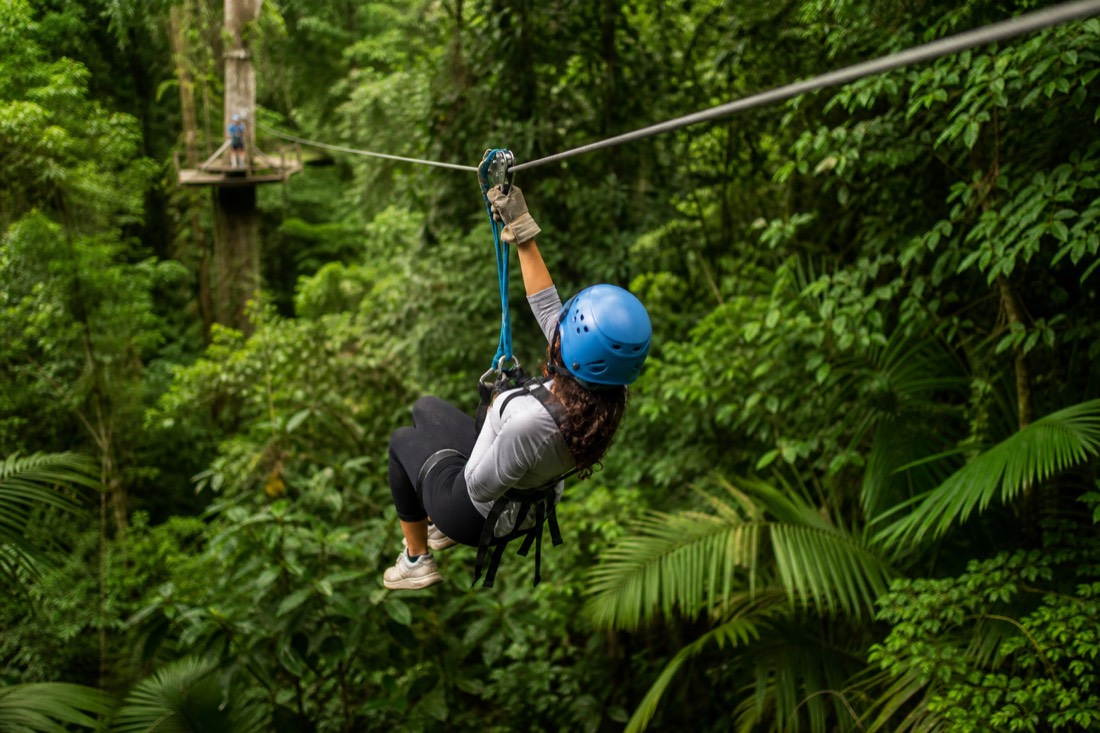
From the shuttle stop, an elevated boardwalk leads you gently into the forest and out to a viewing platform and the river, which is as far as many visitors go, and it is lovely. Push on and you reach the main river-viewing area, then the Rex Creek suspension bridge, which is the gateway to the full rainforest circuit. The circuit is where the forest closes in: buttress roots taller than you, strangler figs wrapped around long-dead hosts, licuala fan palms with fronds you could shelter under. It is a moderate walk, not a hard one, but the surface is natural, so wear grip and take your time when it is wet. For the wider picture beyond this one site, the network of rainforest walks and boardwalks across the region is worth a look before you plan your days. Track conditions and closures are managed by the Wet Tropics Management Authority.
| Walk | Approx length / time | Difficulty | What you see |
|---|---|---|---|
| Elevated boardwalk to the lookout | a few hundred metres, 10 to 15 min | Easy, flat | Canopy, first river views, wheelchair friendlier |
| Track to the main river-viewing area | short, about 15 min return | Easy | Granite boulders and river views; QPWS does not recommend swimming |
| Rex Creek suspension bridge | on the way to the circuit | Easy | The river from above, forest on both banks |
| Rainforest Circuit Track | about 2.4 km, allow an hour | Moderate, some steps and roots | Buttress roots, strangler figs, dense lowland rainforest |
Distances here are approximate. Track lengths and closures do change, so read the trailhead sign for the current numbers when you arrive, and do not assume every path is open after heavy rain.
The suspension bridge is a small highlight in itself. It sways gently as you cross Rex Creek, and it marks the point where the crowds may thin, because many visitors turn back at the main river-viewing area and never see the circuit. On the loop, keep half an eye on the forest floor and half an eye on your footing, since roots and wet rock are common trip hazards. Take it slowly and the walk is a pleasure rather than a scramble.
Can You Swim At Mossman Gorge, And Is It Safe?
QPWS does not recommend swimming at Mossman Gorge. River conditions can change rapidly, with strong currents and submerged hazards, and Queensland Government advice says crocodiles may occur in fresh or clear water, so appearance and upstream location do not establish safety.
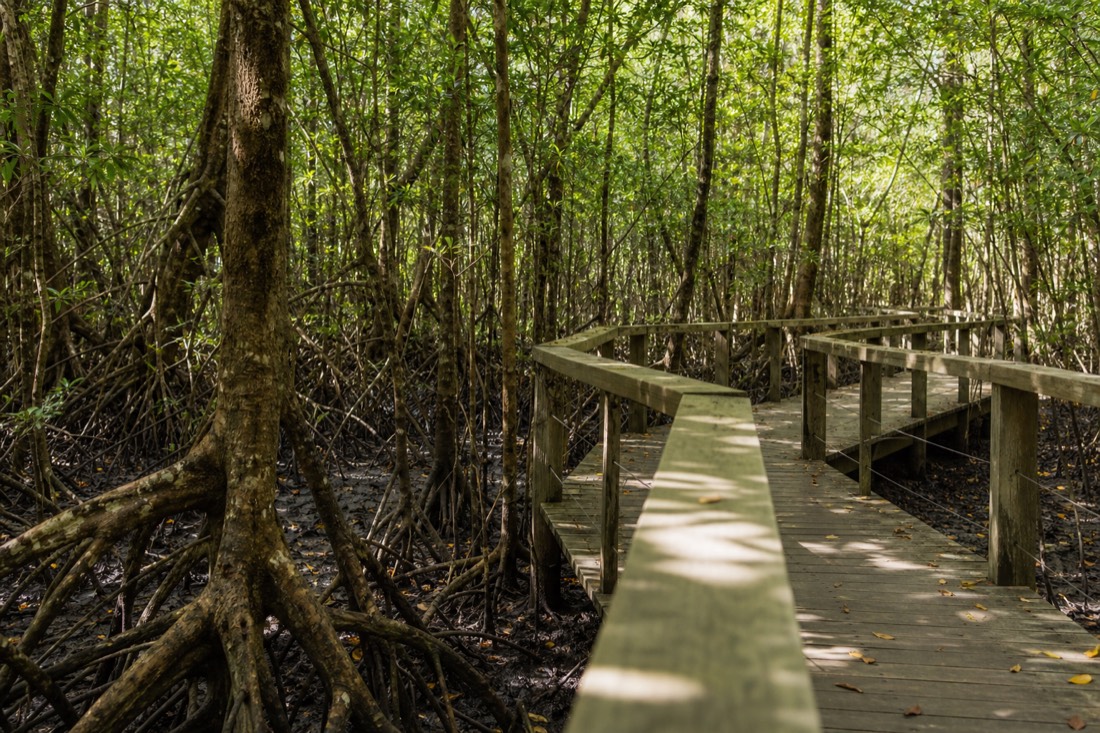
This is not the Daintree River, but freshwater and clear appearance do not establish that water is safe. Queensland Government advice says estuarine crocodiles may occur in fresh or clear water, and QPWS does not recommend swimming at Mossman Gorge because currents and submerged hazards are unpredictable. If you want the wider regional context, see where swimming is restricted or discouraged, and always follow current signs and closures.
QPWS does not recommend entering the water. The boulders are smooth and slick, submerged hazards may be difficult to see, and river levels and currents can change rapidly, including after rain upstream. Keep children away from hazardous edges, obey every warning sign and closure, and do not rely on clear or calm-looking water as evidence of safety. There is no lifeguard on duty. Changing facilities are available back at the centre.
QPWS advises visitors not to enter the water at Mossman Gorge because currents, changing levels and submerged hazards can be dangerous. A guided tour does not override that advice.
What Is The Kuku Yalanji Dreamtime Cultural Walk?
It is a guided walk led by Kuku Yalanji people, the Traditional Owners of this country, that usually opens with a Welcome to Country and a smoking ceremony, then moves through the forest looking at bush foods, traditional medicine plants and ochre, with storytelling along the way. It is the single best way to understand what the rainforest means here.
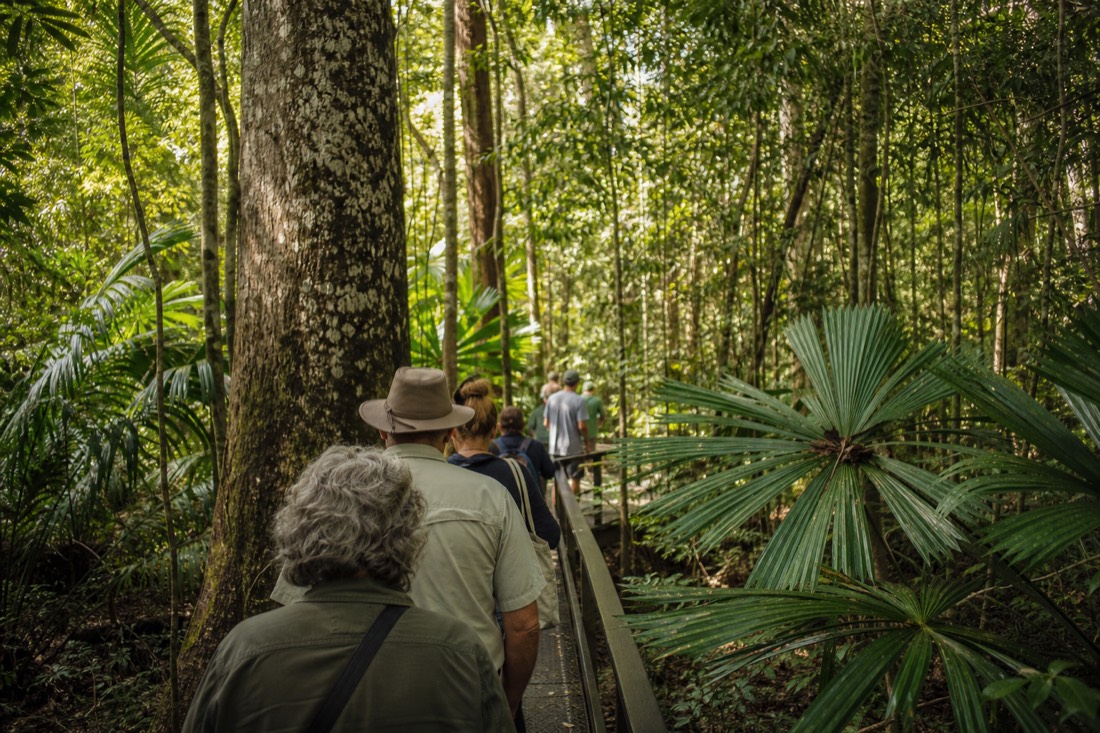
Walking the boardwalk on your own, you see a beautiful forest. Walking it with a Kuku Yalanji guide, you learn which plants carry medicinal properties documented over thousands of years, how the community and the rainforest fit together, and why this is described as the relationship rather than the backdrop. The cultural walks depart from the Mossman Gorge Centre and are booked through it. Some multi-day itineraries build the experience in as well: a two-day waterfall and rainforest tour opens its Daintree day with a Welcome to Country before the gorge, which is a different feeling from arriving cold. To go deeper on what the guides point out, our notes on the ancient plants and bush medicine of the forest pair well with the walk.
What stays with people is usually not a single fact but a shift in perspective. You come away seeing the forest as a place that has been lived in, read and cared for over an immense span of time, rather than as untouched wilderness. That framing is hard to get from a sign, and it is the main reason the cultural walk earns a place in a visit rather than being treated as an add-on. Group sizes are kept small, so booking ahead through the centre is sensible in the busy months.
Ngadiku is the Cultural Centre’s specifically named Dreamtime Walk. The broader cultural tours discussed elsewhere are different experiences; confirm the exact walk when arranging it.
When Is The Best Time Of Day To Visit Mossman Gorge?
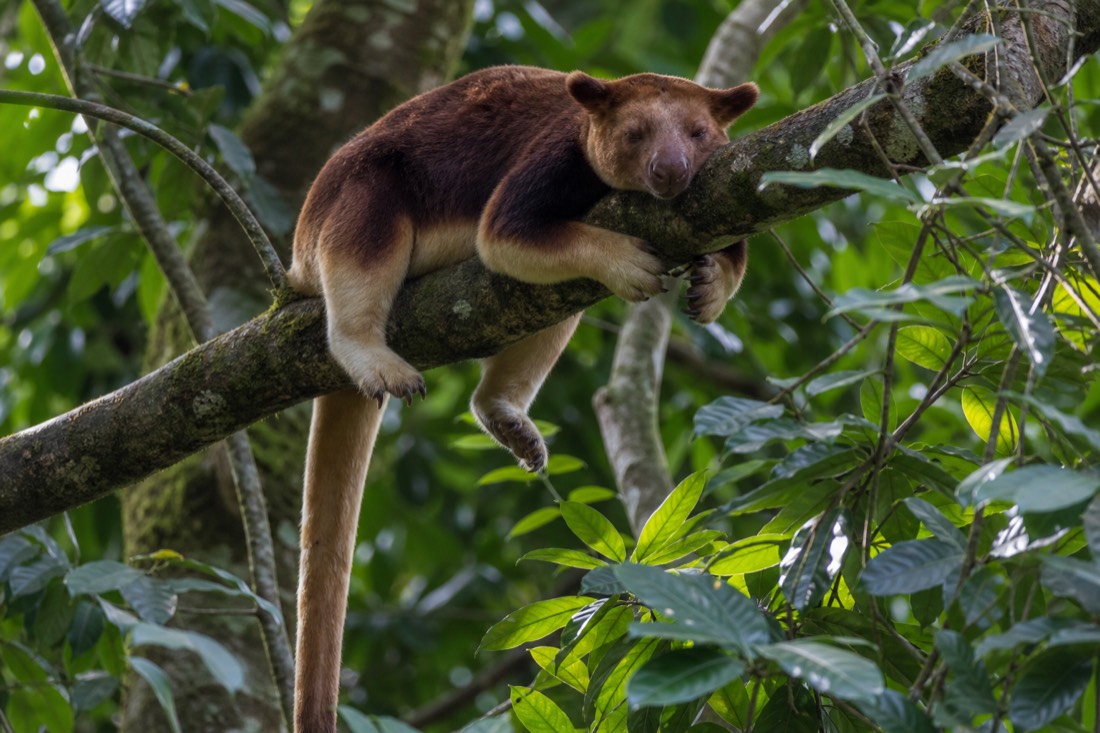
Early morning, before the Cairns coach tours arrive. Get on one of the first shuttles and you get quieter tracks, softer light through the canopy, cooler air for the circuit, and better odds of seeing wildlife. By mid to late morning the site is at its busiest, then it eases again in the afternoon.
The gorge fills up in a predictable rhythm. Big coach groups run up from Cairns and reach the gorge from mid morning, so the window before them is the good one. Early light is also kinder for photos, the boardwalk is cooler before the day heats up, and animals are more active. If a morning slot is impossible, the back end of the afternoon is the second-best bet once the coaches have moved on. Season matters too: the dry months from May to October give the most comfortable walking and the clearest water, while the wet season brings a fuller, louder river and the odd track closure. For the month-by-month picture, see our take on the best months to visit before you lock in dates.
| Time of day | Crowds | What it is like |
|---|---|---|
| First shuttles, early morning | Quietest | Soft canopy light, cool air, best wildlife odds |
| Mid to late morning | Busiest | Coach groups arrive, boardwalk crowded, hotter |
| Early afternoon | Busy, easing | Warm, humid, groups thinning out |
| Late afternoon | Quieter again | Cooler, calmer, coaches gone |
What Should You Bring To Mossman Gorge?
Bring closed walking shoes with grip, insect repellent, reef-safe sunscreen and a hat, drinking water, and a light rain jacket in the wet season. Bring a card or cash for the shuttle and the cafe, and plan to treat the river as a viewing stop because QPWS does not recommend swimming.
You do not need much, but a few things make the difference between a good visit and a soggy one. Mosquitoes and sandflies work the shaded, damp forest, so repellent earns its place. The circuit surface is natural and can be slick, so thongs alone are a poor choice for the walk. In the wet season a packable rain jacket beats an umbrella under the canopy, and water-resistant protection helps keep your phone and keys dry. For a longer trip that spans several stops, our full Daintree packing list goes further than the essentials below.
| Bring | Why |
|---|---|
| Clothing suitable for humid conditions | QPWS does not recommend swimming; choose quick-drying layers for rain and humidity |
| Closed shoes with grip | The circuit has roots, steps and slippery granite |
| Insect repellent | Mosquitoes and sandflies in the shaded, damp forest |
| Reef-safe sunscreen and a hat | Open river sections and the drive get strong sun |
| Water | Warm, humid walking, even in the dry season |
| Light rain jacket (wet season) | Short, heavy showers are normal |
| Water-resistant phone protection and a card or cash | For rainforest rain, the shuttle and the cafe |
Should You Visit Mossman Gorge On A Guided Tour Or By Yourself?
You can absolutely visit independently: drive up, ride the shuttle and walk at your own pace. A guided tour trades some of that freedom for interpretation and transfers. A guide can help explain the forest, but does not make swimming safe; QPWS does not recommend swimming at Mossman Gorge.
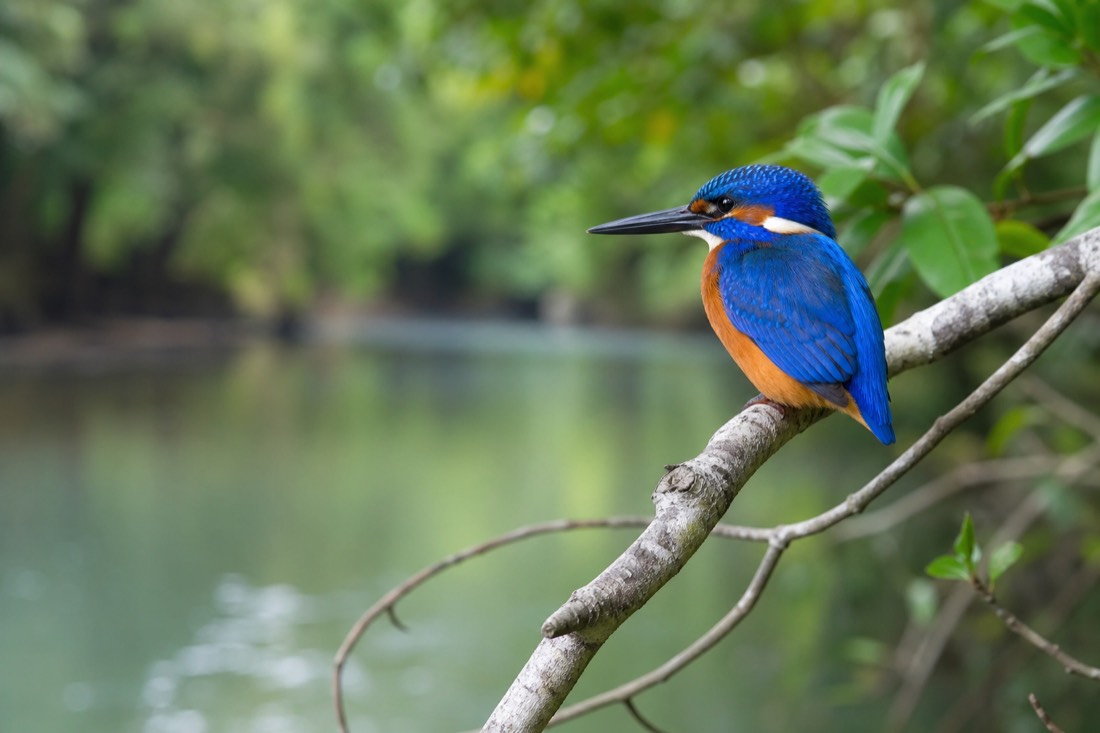
Doing it yourself is simple, cheap and flexible, and there is nothing wrong with it. The catch is that a lowland rainforest hides its best stories from an untrained eye, so a lot of visitors walk straight past a strangler fig, a fan palm or a resting Boyd's forest dragon without a second look. A guide changes that, and the small-group trips also handle the driving and pair the gorge with a river cruise and a run north. A small-group tour from Port Douglas keeps numbers low and reaches quiet corners the coaches skip. If you are still deciding, our honest take on visiting the Daintree without a guide lays out both sides.
| On your own | Guided tour | |
|---|---|---|
| Cost | Lowest: fuel plus the shuttle | Higher, but transfers and fees included |
| Pace | Entirely yours | Set schedule, but well planned |
| What you learn | What you can spot yourself | Plants, wildlife and culture read for you |
| Logistics | You drive, park and time it | Handled, plus a river cruise and Cape Trib often added |
If budget is the deciding factor, going independent is completely valid, and plenty of people do exactly that and love it. If it is your first time in this kind of forest, though, the guided option tends to pay for itself in what you actually notice, from the fig wasp story to the medicinal plant at your elbow, which is the whole reason you came in the first place.
How Much Time Does Mossman Gorge Deserve?
Give it two to three hours, not the forty-five minutes most people spend. That is enough for the boardwalk, the full circuit and time to view the river without rushing. If you want more than the gorge, it slots naturally into a full day that adds the Daintree River and Cape Tribulation.
The temptation is to treat the gorge as a quick photo stop between other things, and the site quietly punishes that: the best of it is the slow part, including the circuit walk and time beside the river, not only the first lookout. Build in enough time to do the loop and let the forest settle around you. Two to three hours is the sweet spot: any less and you are rushing the best of it, much more and you have likely seen what the site offers. From here, a classic full day continues over the ferry to the coast, adds a wildlife cruise on the river and ends near Cape Tribulation, so the gorge becomes the calm opening act rather than the whole show. However you shape it, arrive with enough time for the walk and follow current signs and closures.